Friday 11 September 2026
Scotland Is Seen as a Trauma-Informed Leader. So Why Doesn’t It Feel Like One?
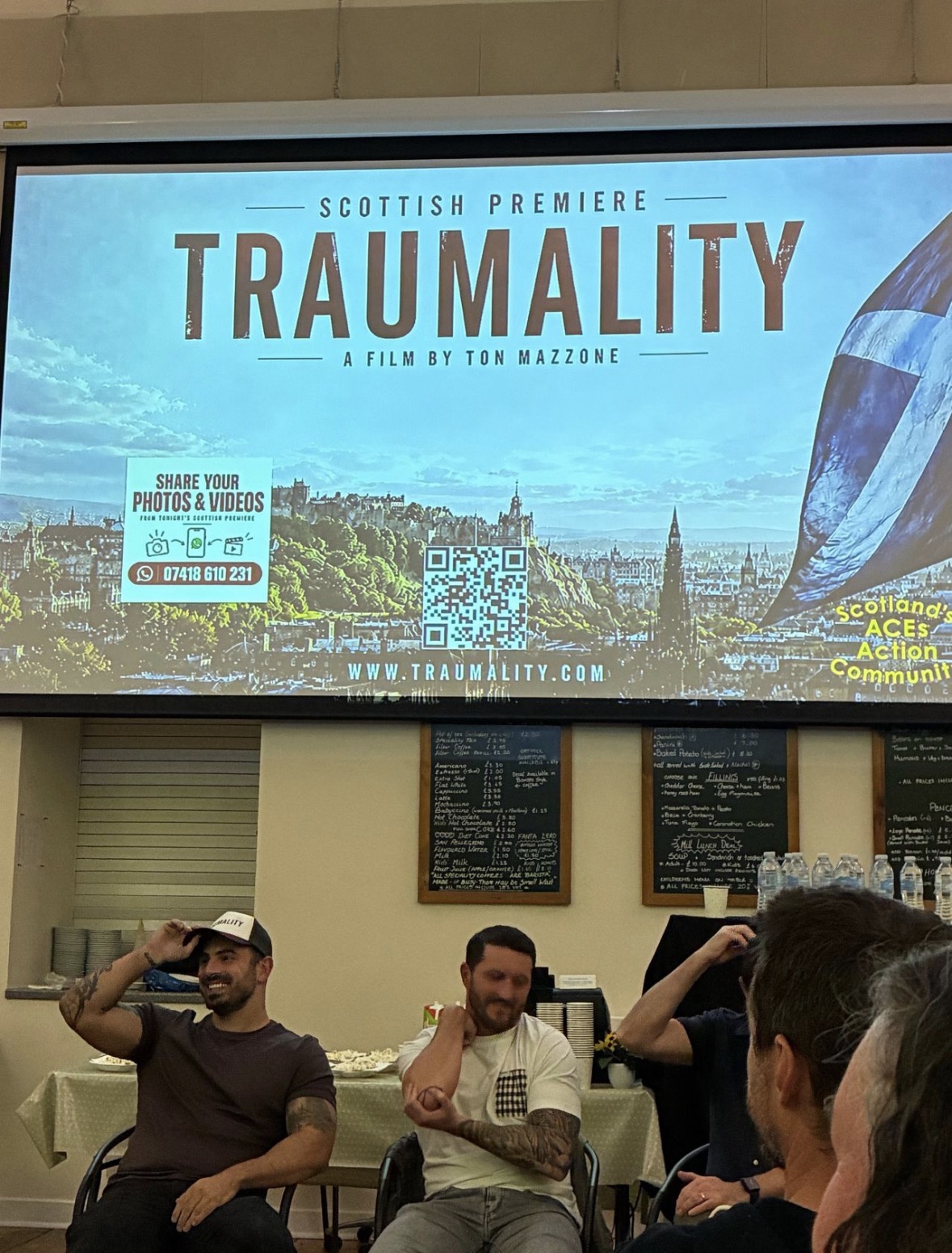
At the Scottish premiere of TRAUMALITY, the conversation exposed the gap between understanding trauma and creating systems that respond differently.
On Friday 11 September, TRAUMALITY arrived in Edinburgh for its Scottish premiere.
Organised by Dr Suzanne Zeedyk and Scotland’s ACEs Action Community, the event brought together people committed to progressing Scotland’s understanding of adverse childhood experiences, trauma and prevention.
Scotland is often described as being ahead of the rest of the UK in recognising ACEs and developing trauma-informed practice. It is featured in TRAUMALITY for that reason.
Yet many people in the room did not feel as though they were living or working within genuinely trauma-informed systems.
That tension became the heart of the evening.
A city shaped by what came before
I took the train to Edinburgh and was greeted by Dr Suzanne Zeedyk and Brett, who showed me around the city centre before the screening.
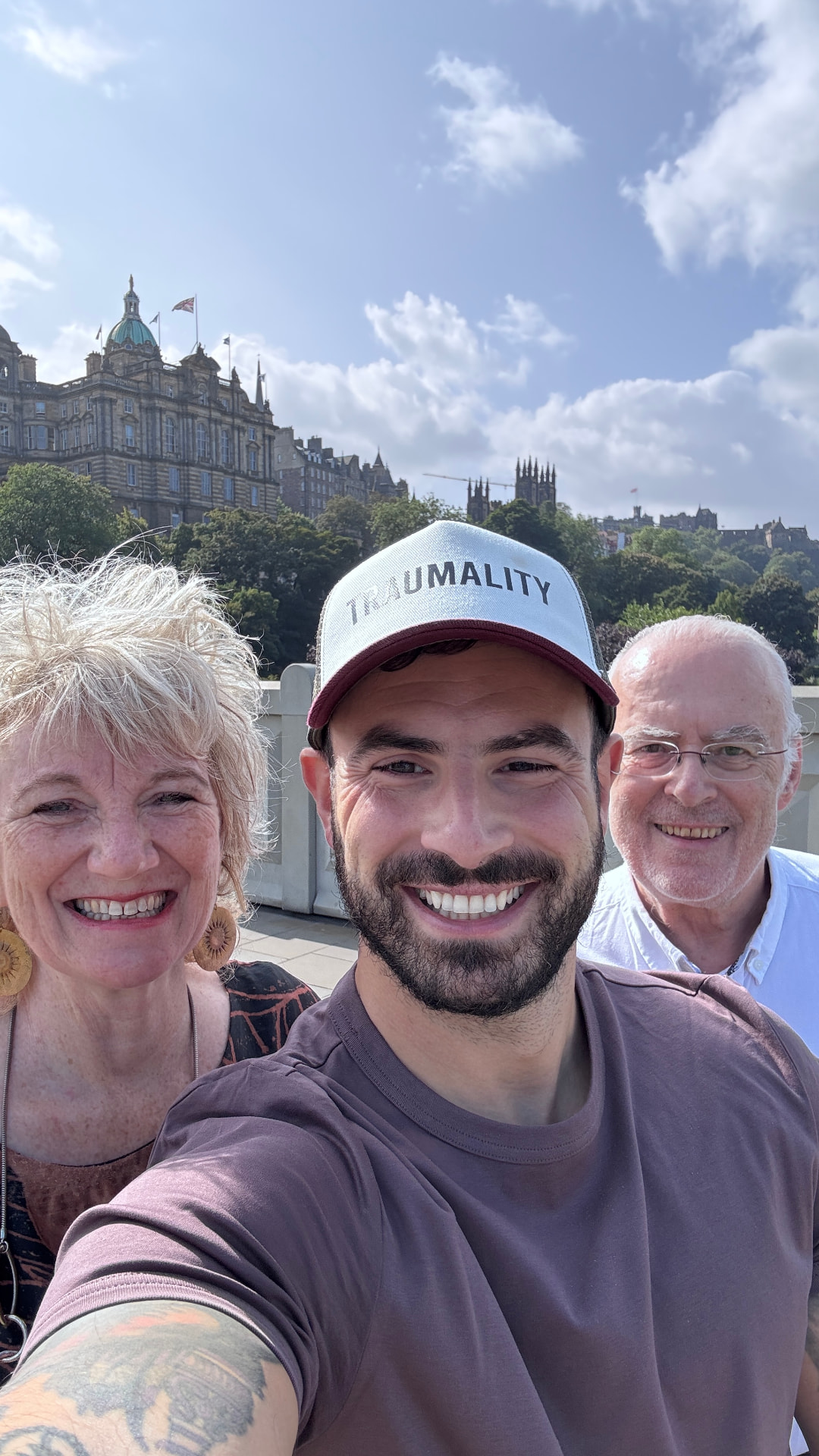
They explained how Edinburgh’s landscape was shaped by glacial erosion. Ice moving around the hard volcanic Castle Rock carved the valleys that now contain Princes Street Gardens and the Grassmarket, while the protected ridge behind the rock became the Royal Mile.
We also passed The World’s End pub. Its name comes from the boundary of Edinburgh’s old walled city. The Netherbow Port once stood nearby as the main gateway through the Flodden Wall. For many people living inside those walls, what lay beyond the gate was effectively beyond their world.
A city whose present shape still carries the imprint of its past felt like a fitting place to bring TRAUMALITY.
The premiere took place at St Joseph’s Centre in Balerno, which Iain Smith generously opened to us. The building first opened in 1828 as Balerno’s parish church before becoming St Joseph’s Church in 1884.
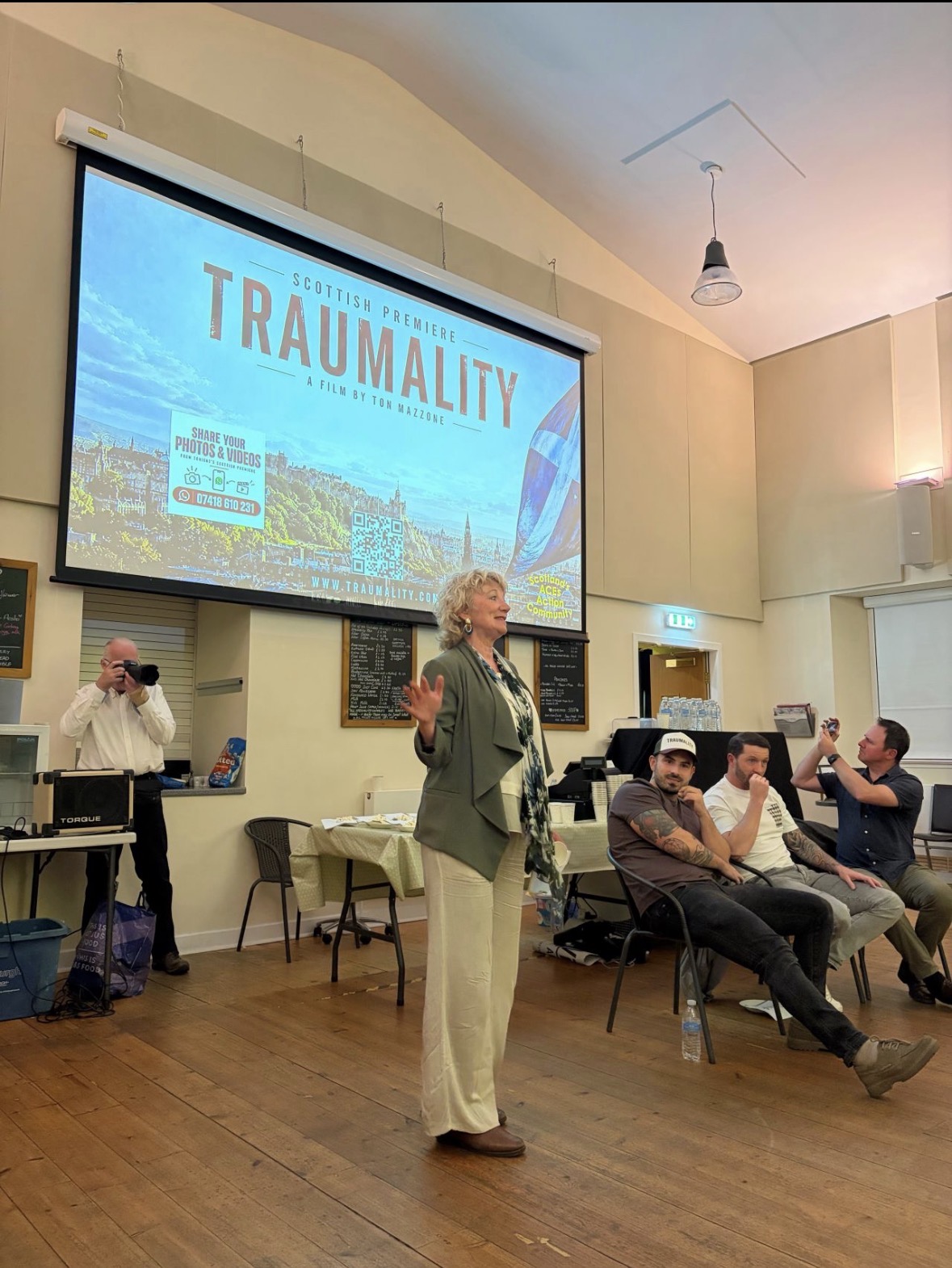
Holding the premiere in Balerno was significant. We wanted it to represent what we hope comes next for TRAUMALITY in Scotland: not one screening in a major institution, but a film that travels from community to community, creating conversations in the places where people live, work and support one another.
Balerno represented the kind of locally led screening we hope to see taking place across Scotland.
Ahead in awareness, but what about reality?
Scotland has made a visible national commitment to understanding trauma, including through its National Trauma Transformation Programme.
That progress matters. But recognition is not implementation.
Following the screening, Scottish educational campaigner David Cameron chaired a panel with James Docherty, Iain Smith and me. David spoke candidly about his frustration with the pace of change and the distance between what Scotland knows about trauma and what people continue to experience within its systems.
We discussed mental health, education and public services, as well as the influence and responsibility of corporations. Responsibility cannot continually be placed solely on teachers, clinicians and frontline professionals. Governments, institutions and businesses also shape how distress is understood, which responses are funded and whether support arrives early or only once somebody reaches crisis.
If the wider system continues to prioritise crisis management and symptom reduction over prevention, relationships and long-term support, trauma-informed language alone will not transform outcomes.
Linda Bendle, who attended the premiere, reflected that although Scotland is hailed as a front runner in trauma-informed policy and practice, substantial gaps remain between policy and people’s experiences.
Having the right language, frameworks and ambitions matter, but ultimately they need to translate into meaningful change for the people our services are designed to support.
Liann Weir, who attended with colleagues from Action for Children Scotland, described TRAUMALITY as “insightful, inspiring, challenging and frustrating, all at the same time”.
She highlighted the contradiction of understanding the impact of traumatic childhood experiences while continuing to pour resources into the sharp end of the system, once things have already gone badly wrong.
One notable absence
Nobody representing the Scottish Government attended the premiere.
During an evening focused on the gap between national ambition and implementation, that absence was difficult to ignore.
Progress cannot be measured only through strategies, training programmes and policy documents. The people shaping those policies must also enter rooms where teachers, practitioners and people with lived experience are explaining what is and is not changing.
If Scotland wants to be recognised as a trauma-informed leader, those with the power to influence its systems must be willing to hear the frustrations as well as celebrate the progress.
When “trauma-informed” is not enough
One of the most affecting contributions came from someone working in a school.
She explained that although her school is described as trauma-informed, some children are carrying levels of trauma that the available support does not seem able to reach. She could see what they were living with and was deeply worried about the direction their lives might take without meaningful help.
Being trauma-informed cannot simply mean completing training or adopting new language. It must be backed by time, resources, consistent relationships, specialist support and early intervention.
Otherwise, professionals may understand what is happening to a child while remaining powerless to change what happens next.
That is not transformation. It is awareness without the ability to respond.
Another audience member asked why the Church was not explored in TRAUMALITY. It was an important question. The role of the Church, and the ways trauma, power, shame, safety and belonging can intersect within it, could be an entire conversation in its own right.
How should progress be measured?
James Docherty challenged us to consider what genuine progress would actually look like.
If Scotland is becoming more trauma-informed, it should eventually be visible in the numbers: fewer children excluded from school, fewer people incarcerated and fewer people receiving mental health diagnoses.
It must also be felt by the people coming into contact with these systems.
It is whether a child, family, patient or professional experiences something different when they need help.
A system cannot measure success only by how many people complete trauma training or how often the right language appears in its policies. It must ask whether lives and outcomes are changing.
Someone also commented on how much TRAUMALITY manages to capture and the many ways in which it could now be used.
The film can begin conversations within schools, NHS teams, councils, charities, workplaces, universities, faith communities and local groups. It connects subjects too often treated separately, including childhood adversity, attachment, the nervous system, diagnosis, medication, relationships, healing and the systems surrounding us.
Scotland may be further ahead in recognising trauma. But the measure of progress is not how fluently a system can talk about it.
It is whether people experience something different when they ask for help.
It is whether exclusions, incarceration and diagnoses begin to decline.
Awareness is not implementation. Training is not capacity. A trauma-informed label is not necessarily a trauma-informed experience.
Thank you to Dr Suzanne Zeedyk and Scotland’s ACEs Action Community for organising the premiere, to every volunteer who gave their time and to Iain Smith for allowing us to use his building in Balerno.
Thank you also to Brett, David Cameron, James Docherty and everyone who attended and contributed so openly.
Bringing TRAUMALITY to Scotland was an important milestone. More importantly, it reinforced the question at the centre of this work:
What are we going to do with what we now know?
0 comments
Join the conversation
Loading comments…